

When any child struggles with reading, parents often wonder the same thing: “Why is reading so hard for my child?”
The answer is often more complex than it seems. Reading isn’t a single skill; it’s a combination of several skills working together at the same time.
A helpful way to understand this process is through Scarborough’s Reading Rope, a research-based model created by literacy expert Hollis Scarborough. This approach, demonstrated as an infographic, shows how different reading skills intertwine and strengthen over time, helping children become more confident and capable readers.
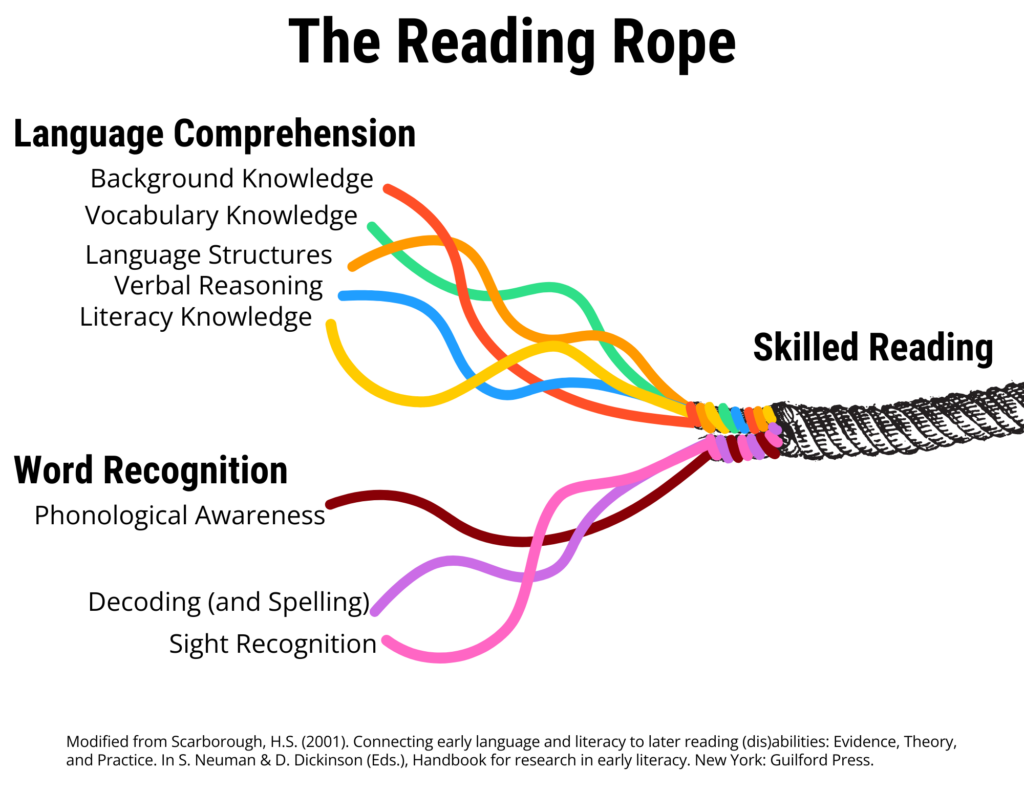
Reading Rope image via https://nwacs.info/aac/topics/literacy/reading/science-of-reading-is-for-everyone/
Understanding how the Reading Rope works can help parents understand why some children struggle with reading, and how the right support can help them succeed.
Why Reading Is More Complex Than It Looks
For many of us adults, reading often feels easy and automatic. But for children learning to read, many skills are developing behind the scenes.
Scarborough illustrated this idea as a rope made of multiple strands. At first, each strand is separate and requires effort. As children practice and build their skills, those strands tighten together, creating effortless reading.
The rope is divided into two main areas:
- Word recognition (reading the words on the page)
- Language comprehension (understanding what those words mean)
When both areas develop together, they lead to strong reading comprehension.
The Skills Every Reader Needs
The lower strands of the rope focus on accurate word recognition. These foundational skills help students read more fluently over time.
Phonological Awareness
Phonological awareness is the ability to hear and work with the sounds in spoken words.
Before kids can read, they need to understand that words are made up of smaller sounds. For example, they learn that the word cat contains three sounds: c-a-t.
Once they recognize these sound patterns, children can begin connecting sounds to letters, which is an essential step in learning to read.
Decoding
Decoding is the process of translating written letters into spoken sounds.
When children decode, they use letter-sound knowledge to read unfamiliar words. This skill is critical in early reading development because it allows students to tackle new words independently.
As decoding improves, reading becomes smoother and more automatic.
Learn more about decoding here.
Sight Word Recognition
Some words appear so frequently that children eventually recognize them instantly without sounding them out.
This process allows readers to store words in their memory for quick retrieval. The more words a child can recognize automatically, the more fluent their reading becomes.
Language Skills That Build Understanding
Reading words is only part of the process. Strong readers also need to understand what those words mean.
The upper strands of the rope focus on language comprehension, the skills that help readers make sense of text.
Background Knowledge
Children understand texts more easily when they already know something about the topic.
For example, a student reading about electricity will understand the material more easily if they already have some basic knowledge of how electricity works.
The more experiences and knowledge children gain, the easier it becomes to connect ideas while reading.
Vocabulary
Vocabulary plays a major role in reading comprehension.
If a child doesn’t know the meaning of important words in a reading, understanding the overall message becomes difficult. As children read more and engage in conversations, their vocabulary grows, making reading easier and more enjoyable.
Language Structure
Language structure includes grammar, sentence patterns, and the organization of ideas within sentences.
Understanding these structures helps readers follow complex sentences and grasp the relationships between ideas.
Verbal Reasoning
Verbal reasoning allows readers to interpret deeper meaning in language.
It helps children understand figurative language, such as metaphors, idioms, and similes. For example, when a story says someone is “as busy as a bee,” readers must recognize that the phrase describes activity, not an actual bee.
Literacy Knowledge
Literacy knowledge refers to understanding how different types of texts work.
Children learn the difference between fiction and nonfiction, recognize story structures, and become familiar with genres such as biographies, poetry, and informational texts.
Experiencing a wide variety of reading materials helps develop this knowledge.
Helping Your Child Become a Confident Reader
Strong readers aren’t born, they’re built through practice, guidance, and the gradual development of many different skills.
When children receive the right support, the strands of their reading rope become stronger and more connected. Over time, reading becomes more automatic, comprehension improves, and confidence grows.
With the right strategies and encouragement, children move beyond simply learning to read and begin reading to learn, opening the door to lifelong learning and curiosity.
Find a location near you to learn how we can help your child build stronger reading skills.