
If you’ve noticed your teenager struggling to finish a single chapter without checking their phone, you’re not alone, and the latest global test scores back you up.
Every three years, the Programme for International Student Assessment (PISA) measures how 15-year-olds worldwide apply their knowledge in reading, mathematics, and science. The exam is given by the OECD, which doesn’t just evaluate facts; it tests critical thinking, active problem-solving, and real-world comprehension.
The latest PISA results deliver a mixed message for Canadian families.
While Canadian teenagers continue to rank among the world’s top performers, national scores have officially hit their lowest point on record.
Canada’s PISA Results at a Glance
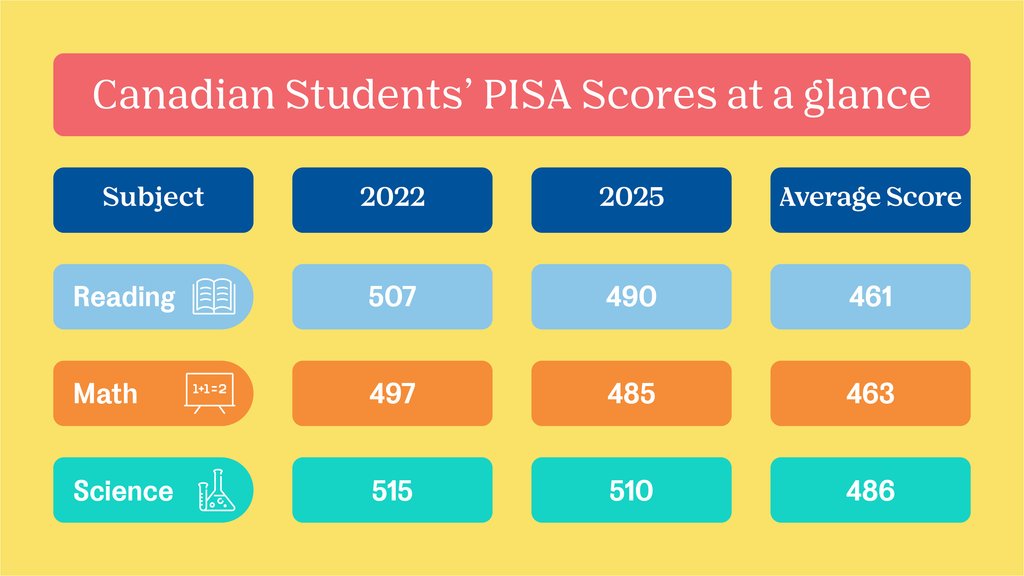
On paper, Canadian students still look competitive, ranking in the top 12 globally across reading, math, and science. But the numbers tell a concerning story: math scores have dropped significantly over the last decade, and reading comprehension is following the same downward trend. Teens aren’t losing intelligence; they’re losing the habit of deep focus.
Science
- Canadian Average: 510
- OECD: 482
- Canada ranks 9th globally
Mathematics
- Canadian Average: 485
- OECD: 463
- Canada ranks 11th globally
Reading
- Canadian Average: 490
- OECD: 461
- Canada ranks 12th globally
Computational Problem Solving
- Canadian Average: 525
- OECD: 500
- Above-average digital reasoning
Why Are PISA Results Slipping? Cellphones, Focus Challenges, and AI Shortcuts
Canada’s PISA results declining mirror what is happening globally. However, a closer look at the OECD data reveals that certain drivers are reshaping student performance in the classroom.
1. Cellphone Distraction in the Classroom
Digital distraction has reached a tipping point.
Over 32% of Canadian students report frequent digital distractions in class (higher than the OECD average of 28%).
OECD experts note that screen access during instruction causes cognitive fragmentation, causing more damage to sustained learning habits than school disruptions during the pandemic.
Here are some screen time stats that you should know.
2. Attention Span Slippage and Executive Function Issues
Constant exposure to short-form video has rewired how teens and adults consume information. We see it every day: students don’t read to understand anymore; they skim to find an immediate answer. When faced with a paragraph that requires analysis, their default instinct is to rush, guess, or swipe away. When a teen’s brain is trained on 15-second clips, sitting down to work through a multi-step word problem feels overwhelming.
Read more about screen vs. paper reading.
3. AI Usage vs. Cognitive Effort
Nearly 40% of Canadian teens use AI chatbots for schoolwork weekly. The data shows something unsurprising: students who rely heavily on AI for homework score lower on standardized tests.
Why? Because when AI generates the outline or solves the equation, the student skips the uncomfortable friction where real learning happens. AI gives them the output, but deprives their brain of the workout.
Keep reading about AI in the classroom.
How Cognitive Learning Reverses the Slide
Reversing this slide isn’t about memorizing more formulas or doing extra worksheets; it’s about retraining how students think. At Oxford Learning, we help teens break free from screen dependence and short attention spans by teaching active, cognitive learning habits:
- We teach students to look at texts, take meaningful notes, and extract core arguments rather than scan for key terms.
- We show students that getting stuck on a hard math problem isn’t a sign to give up or open an AI chatbot; it’s just the first step in solving it.
- Simple, off-screen daily systems that help students organize their thoughts, plan multi-step assignments, and manage digital noise.
Help Your Child Build Lifelong Learning Skills
Is your child skimming through homework, distracted by screens, or struggling to focus?
Contact your local Oxford Learning centre today to learn how our cognitive learning programs build confidence, focus, and academic success for life!